With the beginning of the 2026 Spring semester, the Salida Montessori Charter School opened its doors to a new school building. For several years, the school has been engrossed in the process of planning and applying for grants to secure funding for a new building.
Salida Montessori Charter School’s Head of School, Courtney Landry, explained that the school completed full applications for the Building Excellent Schools Today (BEST) Grant Program four times. According to the Colorado Department of Education, the BEST Grant Program provides schools with funds to resolve health, safety, and security issues in school districts, charter schools, and more. Once, SMCS pulled out their application early due to the knowledge that they would be growing. The BEST Grant supplies the money to build for the current size of the school, so they wanted to expand enrollment before applying again. The school was awarded the BEST Grant later than anticipated, meaning they had less time to prepare a full plan for the building, so they “dove in really, really fast.” Additionally, the BEST Grant requires a match in funds, so the school withdrew a loan from High Country Bank. Along with the grant and loan, the school had been saving for 10 years to build and used those funds for necessities that couldn’t fit within the budget.
The school formed a group of staff and parents to map out their plan, including Landry, Hanley Harvey, Brianna Myers, Marie Walter-Pigg, Haley Trevor and others. This team met at least twice a month, often more, to organize the schools’ construction. After the design process, the school “started building on November 11th of 2024.” On November 12th of 2025, they did their punch walk, which is a walk through to see the progress of construction.
With price shifts throughout the process, the design of the building was continuously changing. As the team decided what was necessary for the building, some things were cut from the plans, and some were altered to stay within budget. Landry explained that one of the biggest changes of price that affected the rest of the building was the increased cost of the HVAC system. The school was encouraged to cut their air conditioning system from the plans, but with past experiences in buildings without air conditioning, the school made other adjustments to fit that into the budget. With higher prices, the school also wasn’t sure if they would be able to open with a playground and new furniture, but managed to cut costs in some places to include those aspects of the school. “There’s a lot of really cautious choices that we made that got us to where we could buy back all those things through the process,” Landry stated.
Before the opening of the new building, the classes were spread across two locations. Now, older students are able to work with the younger classes, such as during read-aloud. Landry explained that having all grades in the building has created a more unified community. This also benefits the school in terms of security. Now, they have all office staff at the front of the building with a controlled entrance, as opposed to “running up and down the stairs and answering the doors.” However, the limited space in the front of the school has made for a small drop off lane. This doesn’t allow as much room for parents to congregate, which has been a challenge for parent involvement. Landry and the rest of the school are currently brainstorming ways to keep parents involved in the school’s systems.
The new building also has a teachers’ lounge and art room. Landry said that with the teachers lounge, “they actually have a space with a window and they can commune in there,” rather than teachers eating lunch in their cars or small office spaces. The art room also allows students to have a dedicated space for creativity. The Toddler’s Rooms each have kitchen sets catered to the size of little kids.
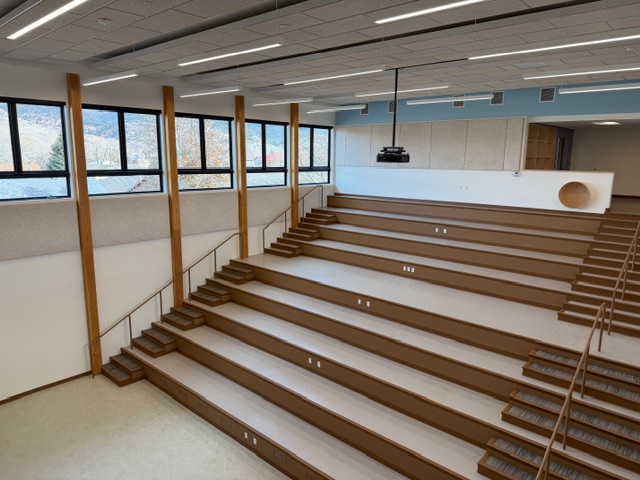
Landry’s favorite part of their new building is the common space termed the “learning stairs.” She noted that the stairs will be the perfect location for the Montessori’s movie nights that regularly take place, as well as a communal space for the full school.
One concern was how to adjust the space for a growing number of students. The BEST Grant allowed for more flexibility when planning for square feet per student, so the school was able to absorb a few more students this year. Landry noted that “if we’re sticking to our numbers that feel appropriate for the space,” there will be very little growth in the future. However, there is space for a second Toddler’s Room, which is hoped to be staffed and opened next year.
The SMCS’s new space provides more interactive opportunities for students and staff, and will help unify the Montessori community within Salida.